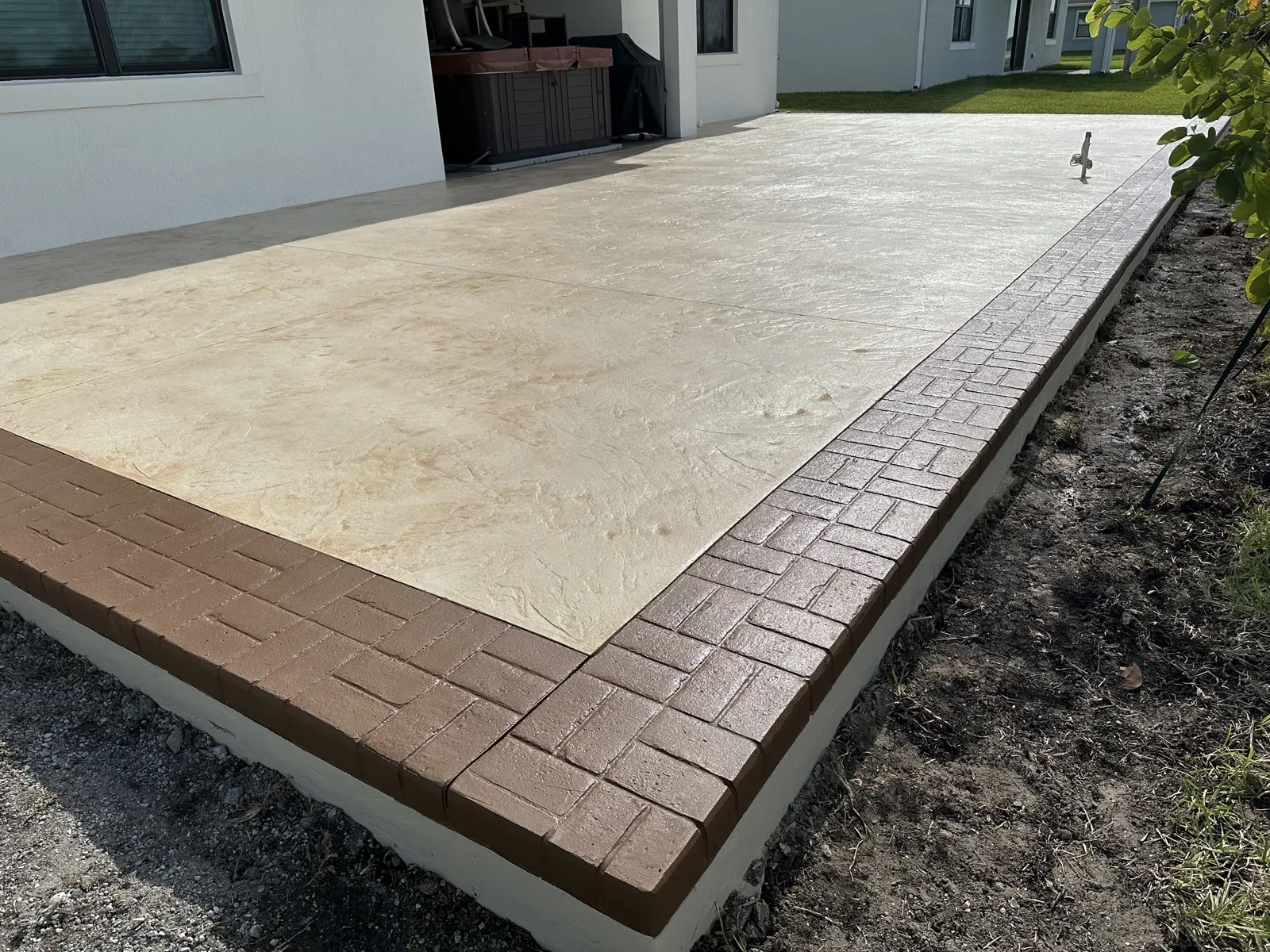
Stamped Concrete or Pavers: Which Is Right for Your Patio or Driveway?
The answer depends on the project, not on which product wins overall. Market guides put stamped concrete at $8 to $19 per square foot installed. Pavers run $10 to $35, and they come apart for repairs, which is their real advantage.
We install stamped concrete and pavers, so the choice comes down to your yard. This post covers cost, repairs, looks, and how each one handles Brevard County weather.
Which is better, stamped concrete or pavers?
Both are strong outdoor surfaces that hold up for decades. Stamped concrete is one poured slab, colored and pressed with a pattern. It reads like stone, brick, or wood plank. Pavers are individual units set on a compacted base with sand in the joints.
That single difference drives everything else. A slab moves as one piece and cracks as one piece. A paver field moves in small units, and any unit can come back out.
Stamped concrete usually wins on price and on custom design. Pavers usually win on spot repair and on getting the space back the same day. Neither one is a mistake for a Brevard patio or driveway.
What do stamped concrete and pavers cost?
The figures below are published market ranges, not our prices. Every yard is different, and a real number comes from looking at the job in person.
| Surface | Installed cost per square foot | Source |
|---|---|---|
| Plain gray concrete slab | $5 to $10 | HomeGuide 2026 |
| Stamped concrete | $8 to $19 | HomeGuide 2026 |
| Stamped, basic single color | $8 to $12 | Contractor guides |
| Stamped, mid range | $12 to $18 | Contractor guides |
| Stamped, hand accented | $18 to $28 | Contractor guides |
| Paver patio | $10 to $17 | HomeGuide 2026 |
| Concrete pavers | $10 to $25 | Contractor guides |
| Brick pavers | $15 to $30 | Contractor guides |
| Natural stone pavers | $25 to $50 | Contractor guides |
For a 20 by 20 patio, HomeGuide’s 2026 figures put stamped concrete at $3,200 to $7,600. Contractor comparison guides put the same 400 square feet in pavers at $4,000 to $14,000.
Across the industry, stamped concrete runs about 20 to 40 percent less than pavers for the same area. Plain gray concrete stays the cheapest hard surface at $5 to $10 per square foot. Pattern and color are what you add on top of that base cost.
What are the disadvantages of stamped concrete?
Concrete cracks. Every slab gets control joints, which are tooled or sawn lines that tell the slab where to move. Hairline cracks can still show up outside those joints as a slab ages.
That rarely changes how the patio performs, and it comes with owning a poured surface. Steel or fiber inside the slab and a well compacted base keep the pieces tight.
Color is the other trade off. Stamped color lives at the surface, and sealer keeps it rich under Florida sun. Contractor guides call for resealing every two to three years. That runs roughly $400 per application on a 400 square foot patio.
Repairs are harder as well. Matching color and texture on an aged slab takes skill, and a patch can still read as a patch. None of that rules the material out. We go over pattern, color, and joint layout before we pour a stamped concrete patio or driveway.
Where pavers earn the higher price
Pavers come out and go back in. A cracked unit, a settled corner, or a trench for a new pipe gets lifted, fixed, and relaid. The repair blends because the same units go back down.
Joint sand is the ongoing task. Sand washes out of the joints in heavy rain, and it gets topped up as normal upkeep. That is a small job compared with resealing a slab.
Pavers are also ready when the crew packs up. A poured slab takes about two days before you walk on it. Cars wait about a week. A paver patio takes furniture the same afternoon.
Design: pattern, color, and custom detail
Stamped concrete copies flagstone, ashlar slate, brick, and wood plank from a single pour. Because the surface is continuous, a pattern can run wall to wall without a cut line. We also hand carve details into the wet slab, like compass stars, medallions, and carved border bands.
Pavers give you real joint lines and a texture you can feel underfoot. Color comes from the unit itself, so the look does not ride on a sealer. Shape and pattern options come from what the units allow, and borders get built from a contrasting unit.
Does Florida change the answer?
Up north, freeze and thaw cycles heave hard surfaces every winter. That is the strongest argument for pavers in cold states, because a flexible surface shifts without cracking. Brevard County does not freeze, so that argument carries much less weight here.
What we deal with instead is sun, rain, and sand. Year round UV is hard on sealer, which is why stamped color needs regular attention. Sandy soil drains fast, and base prep is what decides whether a paver field stays flat.
Summer weather also shapes the schedule. A pour needs a dry window and a cure window, and August afternoons do not always give one.
What about a driveway?
A driveway carries vehicle weight, so what sits under the surface matters more than the surface itself. A stamped driveway gets poured at driveway thickness with steel or fiber inside. A paver driveway uses thicker units over a deeper compacted base.
The cost gap widens on a driveway because the area is larger. A 20 to 40 percent difference per square foot adds up across a full drive.
Repairs cut the other way. Say a water line or a conduit has to run under the surface later. A paver driveway opens up and goes back down in the same units.
Which one is better around a pool?
Both work well around water. Stamped concrete gives one continuous deck with texture worked into the finish for grip. Pavers give a deck you can open up later when a line or a light needs service.
Around a screened lanai, layout and drainage matter more than the material choice. We cover the pool version of this decision on our pool deck page.
Frequently Asked Questions
How much does a 20x20 stamped concrete patio cost?
HomeGuide’s 2026 figures put a 400 square foot stamped patio at $3,200 to $7,600 installed. That lines up with $8 to $19 per square foot. Pattern count, extra color, and hand carved detail move you up the range. The same 400 square feet in pavers runs $4,000 to $14,000.
Which is better around a pool, stamped concrete or pavers?
Both work well. Stamped concrete gives one continuous deck, with texture worked into the finish for grip. Pavers can be lifted and put back when a pool line or a light needs service. Deck size and budget usually decide it, and we price the two options together.
Do pavers or stamped concrete need more upkeep?
They need different upkeep. Stamped concrete gets resealed every two to three years. Contractor guides price that near $400 per application on a 400 square foot patio. Pavers skip sealing, but joint sand washes out in heavy rain and gets topped up. Both surfaces want a wash when dirt builds up.
Can stamped concrete or pavers go over an existing slab?
Yes, when the slab underneath is sound. A stamped overlay bonds a new textured layer onto old concrete. Thin pavers can be set over that same slab instead. Both paths skip demolition and haul off, which keeps the job smaller. A cracked or sinking slab has to come out first.
Getting a real number for your project
The only way to settle this on your property is to price both options side by side. We install stamped concrete and pavers. We can quote the same patio or driveway both ways at one visit.
Estimates are free and done on site in Palm Bay and across Brevard County. Call (321) 215-5817 or contact us to set up a visit.